The United Efik Nations is a socio-cultural organisation established to represent the totality of the various dialectal Efik groups, and to foster unity among such dialectal Efik groups under a singularity. In addition, we enlighten the general public about the Efik ethnic group of Nigeria through provision of digital materials like E-books, videos, literature texts, drama, movies, conferences, etc.
Created December 20, 2019, the United Efik Nations began as a Facebook page designed to reach all descendants of the great Iboku Ibom, descendants who are today designated as Efik, and bring them together for unity and prosperity. The organisation was established to generously cater for the informational needs of people(indigene or not) who seek to know about the history and origin of the Efik, as well as its other numerous cultural facets.
| Name | United Efik Nations |
|---|---|
| Motto | Efik: our tribe, our pride |
| Founded | December 20, 2019 |
| Headquarters | Calabar, Uyo |
| Type | Socio-cultural |
| official website | www.unitedefiknations.com.ng |
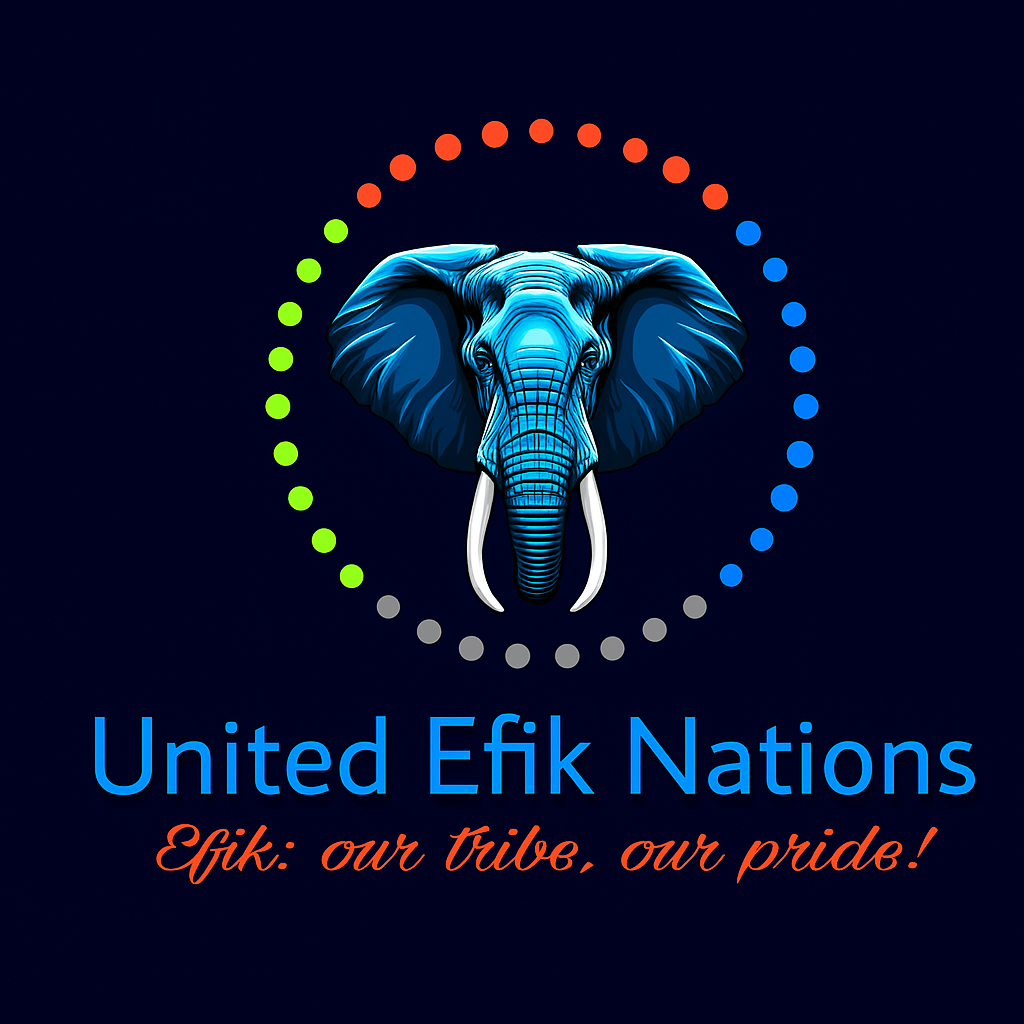
The elephant in the centre represents might and wisdom, and the ring of coloured dots symbolises unity of the various dialectal groups.
The green part of the dotted ring represents prosperity and growth, the orange part represents strength and valour, the blue part represents royalty, while the slategrey part represents the rich culture of the Efik ethnicity.
The motto reads: Efik: our tribe, our pride!
The impetus to create the United Efik Nations stemmed from the propagation of perilous misinformation designed to cause disunity and throw the Efik people into fragmentations. Evidence of investigation shows that these propaganda are in themselves politically motivated either by state actors or erudites, or both, to favour one dialectal group over the other. Suffice it to say that these propaganda are intra-ethnic, meaning, they emanate from among the elite class of the Efik ethnicity. Evidence shows that while the bourgeois and lower classes support Efik unity, the erudite class and state actors support imposition of one dialectal group over another, in the process, denying pristine historical records.
The history of Nigeria can never be complete without the mention of the Efik people and the significant roles they played during the transatlantic slave trade, with Calabar serving as both a major trade port and British administrative headquarters of Nigeria between the 15th and 19th centuries. The Efik people are a large ethnic group in Nigeria's south-south geopolitical zone that compromise the following dialectal groups: Anang, Eburutu, Ejigham, Ekid, Ekoi, Ibeno, Ibibio, Oro, etc. The Efik are found in Akwa Ibom and Cross River States of Nigeria, and then in western Cameroon.
The Efik occupy a prestigious position in the country's epoch of history. Nevertheless, there have been several clandestine attempts—some of them partly successful—since the 1900s to completely rewrite the original history of the Efik, attempts made mostly by some people of the political caste to favour a particular dialectal group. The result of this is that the general public is misled into learning false information about the Efik people, and confusion is sown instead. An example of this is the erroneous belief that Efik and Ibibio are two different tribes or ethnic groups. It is for this reason the United Efik Nations was promptly created in other to instantly correct such fallibility in the society and abrogate further dissemination of inimical, false information that hamper the growth, unity and progress of the Efik people.
To be able to do so, the United Efik Nations as a socio-cultural organisation sources its own knowledge tank about the Efik from genuine and reliable sources such as chieftains of traditional authority, Efik bards and historians well versed in the history and culture of the Efik, and from the horse's mouths of elderly village heads imbued with the pristine knowledge and wisdom of the Efik ancestry.
Because of the politicization of many cultural reading materials written and published by nepotists and state actors to favour a particular dialectal group, the United Efik Nations DOES NOT source its knowledge tank from such books already corrupted with favouritism as its primary source of information in order not to disseminate diluted/wrong information about the Efik to our public audience. Hence, for this reason, readers of our articles may have to adjust their basic understanding of certain terminologies they may come across in our articles or texts.
As a socio-cultural organisation, the primary vision of the United Efik Nations is to maintain the unity of ALL the dialectal groups of the Akwa-Cross region and beyond that make up the Efik family tree under one homogeneous, ethno-cultural identity called "Efik". As earlier mentioned, it is pertinent to point out again that our organisation, the United Efik Nations, stands to represent the totality of all Efik-speaking dialectal groups related by a common ancestry. Thus, when we say Efik, we mean all dialects of the Efik family.
You'll also find out that from now on when we use the word 'Efik', we do not solely refer to the particular dialectal group known as Eburutu (in Calabar land), but the totality of the various Efik-lingual speaking dialectal groups summed up together as one body and soul. We therefore humbly beseech our audience to take note of the disparity between Efik and Eburutu, and dialectal groups and ethnic group used contextually in all our contents.
While Efik refers to the all-encompassing identity for the various dialectal groups, Eburutu refers to one of such dialectal groups natively inhabiting Calabar city. While ethnic group refers to a large group of people with singular language, dialectal groups refer to the different tongues or dialects that make up that large group of people. In this case, Efik would be the ethnic group, and all dialects (Eburutu, Anang, Oro, Efut, etc) would be the different tongues that make up Efik.
The business of uniting all the several dialects into one singularity called "Efik" did not begin with us today. It began since the advent of the Europeans on Calabar soil. When the Europeans arrived at Akwa Akpa(now Calabar), and with the boom of trade activities in the region, there was a need for effective communication because effective communication leads to effective trade and effective administrative control of the Calabar region by the Europeans. For this, Efik was adopted because:
So, when the time came to pick a lingua franca, Efik was easily adopted to capture and represent the various dialects around who all already had mutual intelligibility by virtue of a common ancestry.
Since that time, Efik went on to autonomously become the lingua franca of all the region(Calabar and beyond), and was used in trade, schools, and literature in the years following. This doesn't mean that the other dialectal groups did not exist. In fact, the Ibibios, the Anangs, Oros, Ibenos, Ejigham, Efut etc all undeniably existed, however, it was destiny via access to the Europeans that chose the Efik tongue of Eburutu land, Calabar, to be the umbrella ethnic group for all; eliminating multiplicity of .
Sadly, some people who are non-Eburutu don't like this history. They are too proud to live beside their brother while bearing their brother's name. So, efforts began in the 1900s to rewrite history as they began the propaganda of Efik fragmentation under the guise of state creation.
But we true students of undiluted Efik history each have a responsibility to play at the United Efik Nations. It is our dire responsibility to maintain the unity our fathers laboured for, and not let short-sighted propagandists ruin our today and our future with the gospel of disunity. United we stand, divided we fall.
In accordance with the goal of enlightening our public audience about the Efik ethnic group and maintaining the unity of the Efik dialectal groups under one common generic name, the following are what we do to astutely communicate the subject of Efik to our public audience:
1. We write and publish interesting daily articles about the Efik on this website and on our social media affiliated platforms.
2. We tell Efik folklores, myths and interesting traditional stories on our website.
3. We tell the
pristine history and origin of the Efik.
4. We teach Efik culture, values and traditions to our web audience.
5. We make breath-taking videos that relate to the
passage of knowledge about the Efik available for public consumption.
6. We give out updates in the form of news about daily occurrences in Efik land.
Apart from enlightening our audiences of the sound and undiluted subject of Efik, the United Efik Nations is also on a plethora of missions to attain for the Efik ethnic group. Such missions of the organisation are:
To make of the Efik ethnic group a mighty nation of people who are united in love and prosperity.
Thank you for visiting our website. We are glad to have you. We hope you find ultimate satisfaction with us. Once again, thank you.